

Commentary
Balázs Jarábik
{
  "authors": [
    "Balázs Jarábik"
  ],
  "type": "commentary",
  "blog": "Carnegie Politika",
  "centerAffiliationAll": "",
  "centers": [
    "Carnegie Endowment for International Peace",
    "Carnegie Russia Eurasia Center"
  ],
  "englishNewsletterAll": "",
  "nonEnglishNewsletterAll": "",
  "primaryCenter": "Carnegie Russia Eurasia Center",
  "programAffiliation": "",
  "projects": [
    "Ukraine Initiative"
  ],
  "regions": [
    "Ukraine"
  ],
  "topics": [
    "Domestic Politics",
    "Political Reform",
    "Democracy"
  ]
}
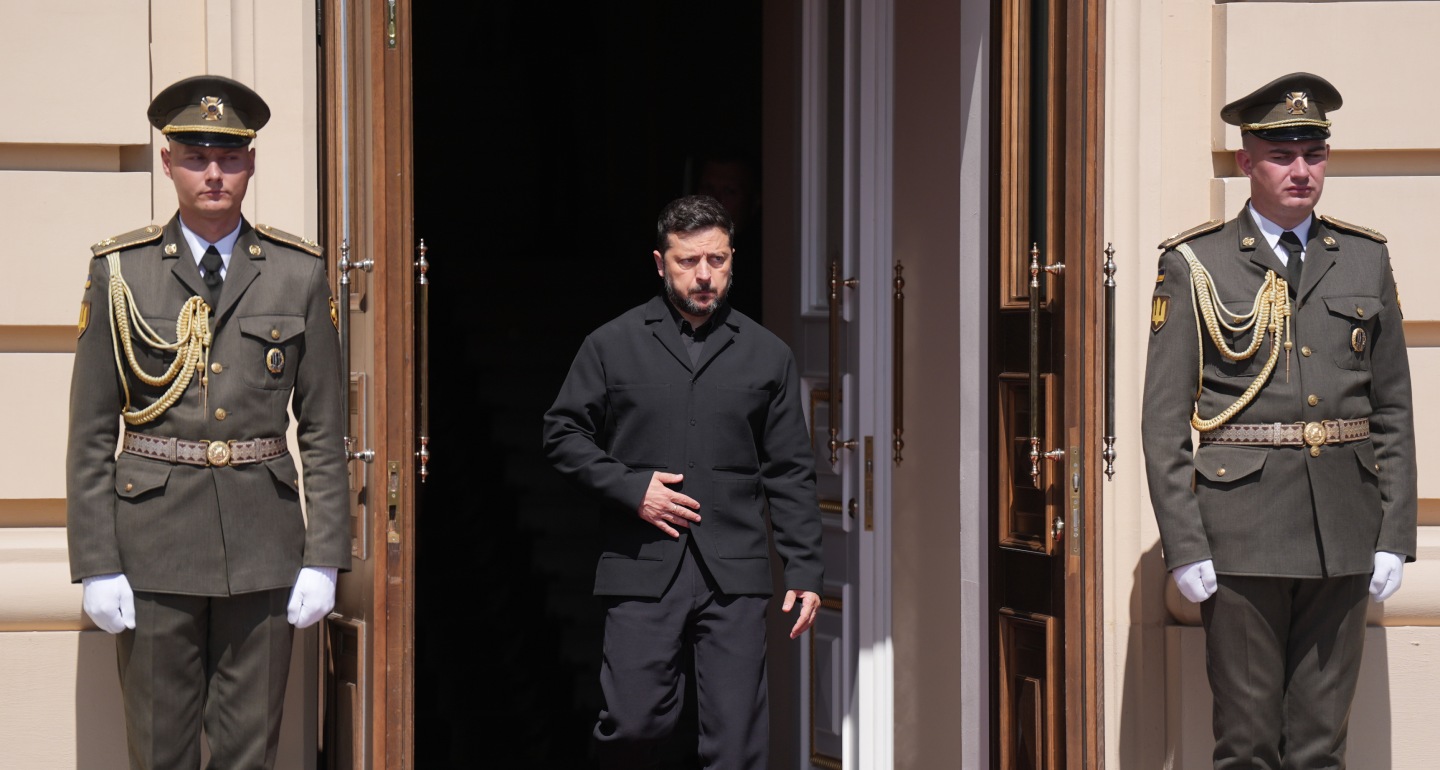
Source: Getty Images
Ultimately, Zelensky sided neither with the reform camp nor with the military establishment as such, but with political control.
In the space of just a few days, Ukraine has undergone a major overhaul of its leadership. It has a new government with a new prime minister, a new commander-in-chief, and a number of other high-ranking security officials. The most surprising dismissal for both local observers and Western partners was that of Defense Minister Mykhailo Fedorov. At the height of Ukraine’s drone warfare success, President Volodymyr Zelensky removed the minister most closely associated with innovation and reform—and then, facing a public backlash, conceded to the removal of commander-in-chief Oleksandr Syrsky as well.
The changes reflect a broader political choice in favor of political cohesion over disruptive reform at the nexus of the state: the security sector, which now consumes 60 percent of public expenditure.
Preparations for the reshuffle had been underway for months, driven by several developments. The Kremlin’s rejection of a ceasefire reinforced the expectation of another prolonged phase of the war, including over another winter, with all its challenges. In addition, Ukraine’s external position has improved considerably. The first tranche of the EU’s 90 billion euro defense financing package has been disbursed, while NATO’s Ankara summit confirmed the West’s readiness to support Kyiv’s war effort in the long term.
Finally, Ukraine’s successful deep-strike campaign against Russia’s energy sector has generated optimism that innovations can shift the strategic balance. Yet along the front line, Russian troops continue to gain ground, while Ukraine’s manpower shortages and public resistance to forced conscription remain the defining constraints in its rear. The gap between the narrative of technological adaptation and the reality of an attritional land war is widening.
Against this backdrop, Zelensky decided to reset the executive in preparation for a longer war. The previous government of Yulia Svyrydenko, formed to placate corruption charges in the wake of the Mindich scandal, was politically weak and never developed an independent support base in parliament.
In addition, a few of its ministers had become a liability for the president’s team. Deputy Prime Minister for Development Oleksii Kuleba faced corruption allegations and mounting public pressure over a series of governance failures. Meanwhile, Deputy Prime Minister for Eurointegration Taras Kachka, the principal architect of the Kachka–Kos understanding with the European Commission, had become closely associated with judicial and law-enforcement reforms instrumental in unlocking the EU’s 90 billion euro financial package. His replacement was designed to ease the tension between satisfying Brussels’ conditions and preserving political control over law enforcement institutions.
The reshuffle was anything but smooth, and entailed weeks of bargaining with various parliamentary factions. The resulting appointment of Serhii Koretsky as the new prime minister reflects Zelensky’s priorities. A successful executive of Ukraine’s largest state energy company Naftogas, he owes his position directly to the president. Unlike Fedorov, he has never built an independent political constituency. That combination of loyalty, managerial competence, and capability to deliver without becoming an autonomous political actor makes him an attractive choice for the presidential administration.
The personnel shakeup extends well beyond the government. Simultaneous changes across the Security Service (SBU), the National Security and Defense Council (NSDC), and the National Police point to a broader consolidation of authority in the president’s hands. Unlike his predecessor Vasyl Malyuk, who enjoyed certain autonomy, the new head of the SBU, Oleksandr Poklad, is a controversial figure closely aligned with the presidential administration—but is at odds with its head Kyrylo Budanov. His appointment, together with Interior Minister Ihor Klymenko’s move to head up the National Security and Defense Council and the appointment of a new National Police leadership associated with the deputy head of the presidential administration Oleh Tatarov, suggests a deliberate effort to tighten political coordination across the institutions that control coercive power.
The replacements come after anti-corruption investigations once again began reaching senior figures around the president, reviving tensions between the presidential administration and independent anti-corruption institutions. Whether this will translate into renewed pressure on the National Anti-Corruption Bureau of Ukraine remains to be seen, but the personnel changes clearly strengthen the presidential administration’s ability to shape the relationship between the security services and Ukraine’s law-enforcement architecture.
Overall, the reshuffle suggests that once Ukraine’s external financial and security position became more secure, Zelensky shifted his priority from accommodating reform-driven power sharing to restoring centralized political control over the institutions that will define Ukraine’s conduct of a longer war. Control above reform has become the organizing principle of the new executive.
No part of the restructuring generated more controversy than the dismissal of Defense Minister Fedorov. At the very moment when Ukraine’s long-range drone campaign was reshaping perceptions of the war, Zelensky removed the minister most closely associated with seemingly turning the tide.
Measured against his own agenda, Fedorov had few reasons to leave. During his brief tenure, he accelerated procurement reform, expanded investment in the defense industry, digitized military management, increased frontline pay, introduced fixed-term contracts, and pushed for a more professional model of recruitment, including a significant expansion of foreign volunteers. He also initiated an internal audit that reportedly identified billions of dollars in inefficient spending. Moreover, Fedorov became the public face of a new theory of victory: that technological innovation, drones, and organizational reform could offset Russia’s structural advantages in manpower and firepower.
That narrative, however, collided with battlefield reality. Ukraine’s drone campaign raised the cost of Russia’s war and boosted Kyiv’s reputation in the West, but remained dependent on Chinese components. Nor have drones alleviated Ukraine’s manpower deficit. Russian forces continue to advance across much of the front, while Ukraine’s mobilization faces growing resistance and declining efficiency. Fedorov suggested relying primarily on professionalization, technology, and foreign recruitment, but this ambitious vision struggled to address the immediate requirements of an attritional ground war.
Moreover, Fedorov had openly challenged Syrsky’s approach to the war and publicly argued for replacing the military leadership. This criticism resonated with parts of the defense technology community, military bloggers, and reform-minded veterans, turning an internal dispute into a political crisis.
Fedorov’s subsequent dismissal reflected Zelensky’s longstanding approach to governance: preventing the politicization of the military and ensuring that ministers implement policy rather than develop independent political agendas. Fedorov crossed both these lines, threatening the coherence of the wartime leadership.
In response, Zelensky ultimately opted for a political compromise, replacing first the defense minister and then, following protests, the commander-in-chief. The new acting defense minister is Yevhenii Khmara: reliable with no apparent political ambition. Syrsky has been replaced by the younger and more popular Mykhailo Drapaty. A veteran of the Donbas war in 2014–15, Drapaty rose from junior command positions through battlefield merit and has become one of Ukraine’s most respected military leaders.
Following his dismissal, Fedorov has become the political face of an alternative vision for managing the war. The latest opinion polls put him third among potential presidential candidates. If he remains within the presidential camp, his elevated political potential may prove more problematic for other potential presidential contenders, particularly former commander-in-chief Valerii Zaluzhny (who, unlike Fedorov, largely avoided making his disagreements with the president public), than for Zelensky himself.
The underlying dispute remains unresolved. At its core, the conflict is about who bears political responsibility for coercive mobilization in a protracted war. Fedorov offered a politically attractive alternative centred on drones, technology and professionalisation. That narrative resonates particularly with Ukraine’s urban, reform-oriented middle class and defense tech community—but the army’s top brass was originally behind Syrsky.
Ultimately, Zelensky sided neither with the reform camp nor with the military establishment as such, but with political control. His latest appointments reaffirm his principle that no institution or individual, regardless of popularity or wartime achievements, should be allowed to evolve into an independent centre of political authority. Whether this consolidation ultimately strengthens Ukraine’s capacity to sustain a long war remains an open question.

Political analyst, former Slovak diplomat, and consultant specializing in Eastern Europe
Recent Work
Balázs Jarábik
Balázs Jarábik
Carnegie does not take institutional positions on public policy issues; the views represented herein are those of the author(s) and do not necessarily reflect the views of Carnegie, its staff, or its trustees.

The European far right might fail to steer EU policy in the direction Russia wants, but they will create enough chaos inside Europe to benefit the Kremlin.

Dimitar Bechev

If the Russian-speaking community in Latvia cannot articulate their interests without being seen as disloyal, they could end up embracing a pro-Kremlin agenda.

Sergejs Potapkins

Russia’s ruling party would have benefited from Putin appearing as its distant patron, but as an active frontman imposing his views on the public, he has done nothing but harm both the party’s election campaign and the ruling system overall.

Andrey Pertsev

Depleted financial reserves and a shrinking tax base mean it is no longer possible to simultaneously deliver high defense spending, price stability, and economic growth.

Alexandra Prokopenko
Blurring the line between humans and animals is a long-standing tradition in social utopian prose. In his latest novel, Leonid Bershidsky reminds us that in social experiments, people are often treated no differently than animals.

Alexander Baunov